

This Week in Comprehensive Fitness
October 18–23, 2026 | Nine Domains. One Comprehensive Approach.
What did we learn this week about living healthier, leading better, and preparing for whatever life brings?
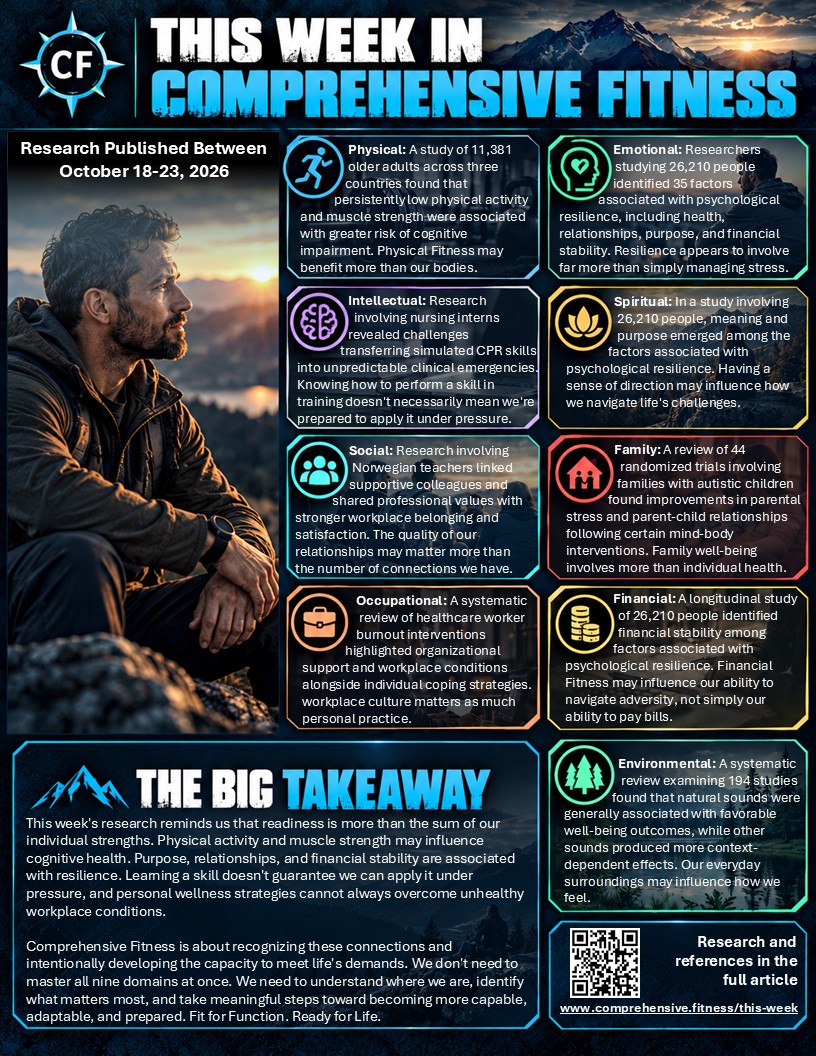 This week’s research reinforced something central to Comprehensive Fitness: our well-being isn’t determined by one habit, one skill, or one area of life. From the relationship between strength and cognitive health to the influence of workplace culture, family relationships, and our surroundings, the evidence continues to reveal important connections. Here are nine takeaways worth considering.
Physical Fitness: Train for Function, Not Just Fitness
New research reinforced the importance of maintaining muscular strength and regular physical activity, particularly as we age. A study involving more than 11,000 older adults found that consistently low activity and strength were associated with a greater likelihood of later cognitive impairment, although it couldn’t establish causation [1]. A separate randomized trial found that 12 weeks of elastic-band resistance training improved strength and walking performance among older women at risk of muscle loss [2]. The practical lesson is simple: train for the things you want to remain capable of doing, whether that’s responding to an emergency, keeping up with your children, or living independently later in life.
Emotional Fitness: Resilience Is Bigger Than Stress Management
One of the week’s most substantial studies followed more than 26,000 people and identified relationships between psychological resilience and several aspects of life, including health, relationships, purpose, financial stability, and everyday behaviors [3]. The research doesn’t prove that improving any one factor will increase resilience, but it challenges the idea that resilience is simply about managing emotions or pushing through adversity. A separate review of workplace burnout interventions reinforced the importance of organizational support and working conditions alongside individual coping skills [4]. Emotional Fitness involves developing useful skills while recognizing the circumstances that influence our ability to use them.
Spiritual Fitness: Purpose and Values Give Our Efforts Direction
The resilience study identified meaning and purpose among several factors associated with psychological resilience [3]. Another study, involving Norwegian teachers, found that shared professional values and supportive relationships were associated with greater job satisfaction and belonging [5]. Neither finding establishes that a particular belief system produces better outcomes, but both invite us to consider what gives our actions meaning. Spiritual Fitness isn’t limited to religion; it includes the values, beliefs, and sense of purpose that help guide our decisions. The question isn’t simply what matters to us, but whether our everyday choices reflect those priorities.
Intellectual Fitness: Learning Isn’t Complete Until We Can Apply It
Several studies challenged assumptions about how people learn and demonstrate competence. An experiment found that students learning complex concepts performed better when classifying provided examples than when generating their own, while those generating examples were more likely to overestimate their learning [6]. Another study, involving nursing interns, described the difficulty of transferring simulated emergency skills into unpredictable real-world situations [7]. Whether we’re learning a professional skill or developing a personal capability, understanding the steps is only part of the journey; knowing when, why, and how to apply them matters just as much.
Social Fitness: Connection Requires More Than Contact
Research examining workplace relationships found associations between supportive colleagues, shared values, and a stronger sense of belonging [5]. Although the research involved teachers and cannot establish causation, it offers a useful perspective on what makes relationships meaningful. Social Fitness isn’t simply about how many people we know or how frequently we interact with them. It’s about developing relationships in which people experience respect, support, and genuine connection. Consider whether you’re simply maintaining contact with the people in your life or actively contributing to those relationships.
Family Fitness: What Affects One Person Can Affect the Whole Family
A systematic review of 44 randomized trials examined mind-body interventions involving families with autistic children [8]. Researchers identified improvements in several outcomes, including parental stress, parent-child relationships, and family quality of life, although the strength of the evidence varied. These findings concern a specific population and shouldn’t be assumed to apply equally to every family. Still, they illustrate an important principle: family members influence one another through their behaviors, relationships, and shared circumstances. Improving Family Fitness may begin with something as practical as changing how we communicate, respond to stress, or support one another.
Financial Fitness: Stability Creates Options
Research examining psychological resilience identified financial stability among several factors associated with later resilience [3]. The Consumer Financial Protection Bureau describes financial well-being in terms of managing everyday finances, handling unexpected expenses, progressing toward goals, and maintaining freedom of choice [9]. These ideas remind us that Financial Fitness isn’t simply about accumulating wealth; it’s about understanding our circumstances and developing greater security and flexibility. Progress will look different for everyone, but informed decisions remain a useful place to begin.
Occupational Fitness: Wellness Is a Shared Responsibility
A systematic review of healthcare worker burnout interventions identified the importance of leadership, organizational support, and the conditions in which employees work [4]. Research involving Norwegian teachers also found associations between supportive workplace relationships, shared values, and professional well-being [5]. These studies don’t establish a universal formula for healthy organizations, but they reinforce an important distinction: employees can develop effective coping strategies while still facing unnecessary demands or inadequate support. Healthy organizations need people who take responsibility for their development and leaders willing to examine whether workplace practices support or undermine that development.
Environmental Fitness: Create Conditions That Support the Life You Want
One of the week’s most interesting systematic reviews examined 194 studies of sound environments and human well-being [10]. Natural sounds generally showed favorable associations across several outcomes, while the effects of human-generated sounds depended more heavily on the setting and circumstances. The findings remind us that our surroundings can offer more than the absence of noise, clutter, or hazards. Environmental Fitness invites us to ask a more constructive question: What conditions could we intentionally create to make healthy choices, meaningful work, and genuine recovery easier?
Bringing It All Together
If one idea connects this week’s research, it’s that having a resource or capability isn’t the same as being able to use it effectively.
Strength matters, but so does functional movement. Knowledge matters, but so does application. Resilience matters, but so do the circumstances in which we’re expected to demonstrate it.
This is why Comprehensive Fitness considers nine interconnected domains rather than focusing on any single measure of wellness. We don’t need to improve everything at once, and no one has every domain figured out.
The opportunity is to recognize where we are, identify what matters most, and take the next useful step.
Fit for Function. Ready for Life.
References & Further Reading
The numbered references below link directly to the original research or authoritative source. Some studies inform more than one domain, so the same reference number may appear in several sections.
[1] Physical & Intellectual Fitness
Song, L., Chen, Y., & Lin, P. (2026). Joint longitudinal trajectories of physical activity and muscle strength and incident cognitive impairment: Evidence from three national aging cohorts. International Journal of Behavioral Nutrition and Physical Activity.
https://doi.org/10.1186/s12966-026-01999-6
[2] Physical Fitness
Su, Y., Li, P., Liu, H., et al. (2026). Elastic band resistance training improves physical function, gait, cardiac indices, and corticomuscular coherence in older women at risk of sarcopenia: A randomized controlled trial. BMC Geriatrics.
https://doi.org/10.1186/s12877-026-08498-0
[3] Emotional, Spiritual & Financial Fitness
Ning, K., Kim, Y., Fan, X., et al. (2026). Understanding psychological resilience: A longitudinal environment-wide association study in Hong Kong. Nature Mental Health.
https://doi.org/10.1038/s44220-026-00742-1
[4] Emotional & Occupational Fitness
Carpenter, J., Das, A., Treish, S., et al. (2026). A systematic review of global interventions for sustainable strategies to reduce healthcare worker burnout and turnover in underserved areas of the United States. Human Resources for Health.
https://doi.org/10.1186/s12960-026-01104-9
[5] Spiritual, Social & Occupational Fitness
Skaalvik, E. M., & Skaalvik, S. (2026). Shared values and social support as predictors of teachers’ motivation and well-being. Social Psychology of Education, 29, Article 132.
https://doi.org/10.1007/s11218-026-10310-1
[6] Intellectual Fitness
Steininger, T. M., Voss, T., & Wittwer, J. (2026). Replicating the advantage of classifying over generating examples in an authentic relational category learning context. Instructional Science, 54, Article 72.
https://doi.org/10.1007/s11251-026-09823-1
[7] Intellectual & Occupational Fitness
Li, M., Liu, H., Huang, H., et al. (2026). From team-based cardiopulmonary resuscitation simulation training to clinical practice: A qualitative study. BMC Medical Education.
https://doi.org/10.1186/s12909-026-10674-0
[8] Family Fitness
Ng, T. Y. C., Yang, H., Chan, L. M. L., & Kwok, J. Y. Y. (2026). A family systems perspective on mind–body interventions in families with autistic children: A systematic review and meta-analysis. Adolescent Research Review.
https://doi.org/10.1007/s40894-026-00292-8
[9] Financial Fitness
Consumer Financial Protection Bureau. (n.d.). Why financial well-being?
https://www.consumerfinance.gov/consumer-tools/financial-well-being/about/
[10] Environmental Fitness
Guo, X., Schmidt, S., Chen, Z., Yang, L., Liu, J., & Albert, C. (2026). Beyond noise and silence: Urban soundscapes and their contribution to human well-being—a systematic review and meta-analysis. npj Urban Sustainability, 6, Article 130.
https://doi.org/10.1038/s42949-026-00482-2
Research note: This article synthesizes research published or reviewed during October 17–23, 2026. The cited evidence includes randomized trials, observational studies, systematic reviews, and authoritative guidance. Findings vary in certainty and applicability. Associations should not be interpreted as proof of cause and effect, and results from specific populations may not generalize to everyone.