

The Eight Troop Leading Procedures: A Framework for Getting Things Done

Leadership isn’t just about knowing what needs to happen. It’s about knowing how to make it happen.
As a young Army corporal and later a sergeant, I relied heavily on a simple framework called the Eight Troop Leading Procedures (TLPs).
They gave me a starting point. When I received a mission, regardless of how complicated or unfamiliar it seemed, I had a process to work through. Eight steps that helped me organize my thoughts, prepare my soldiers, and accomplish the mission.
As I progressed through the ranks and gained experience, something interesting happened. I stopped thinking about the individual steps.
What began as a memory jogger became intuitive. Less of a checklist and more of a way of thinking. It wasn’t necessarily something I consciously worked through anymore. It was simply how I made things happen.
And here’s what I’ve come to appreciate even more since retiring from the Army: The process works just as well outside the military.
Whether you’re leading a small team, managing a major organizational initiative, planning a family event, or coordinating a community project, the underlying principles remain remarkably consistent.
The Eight Troop Leading Procedures
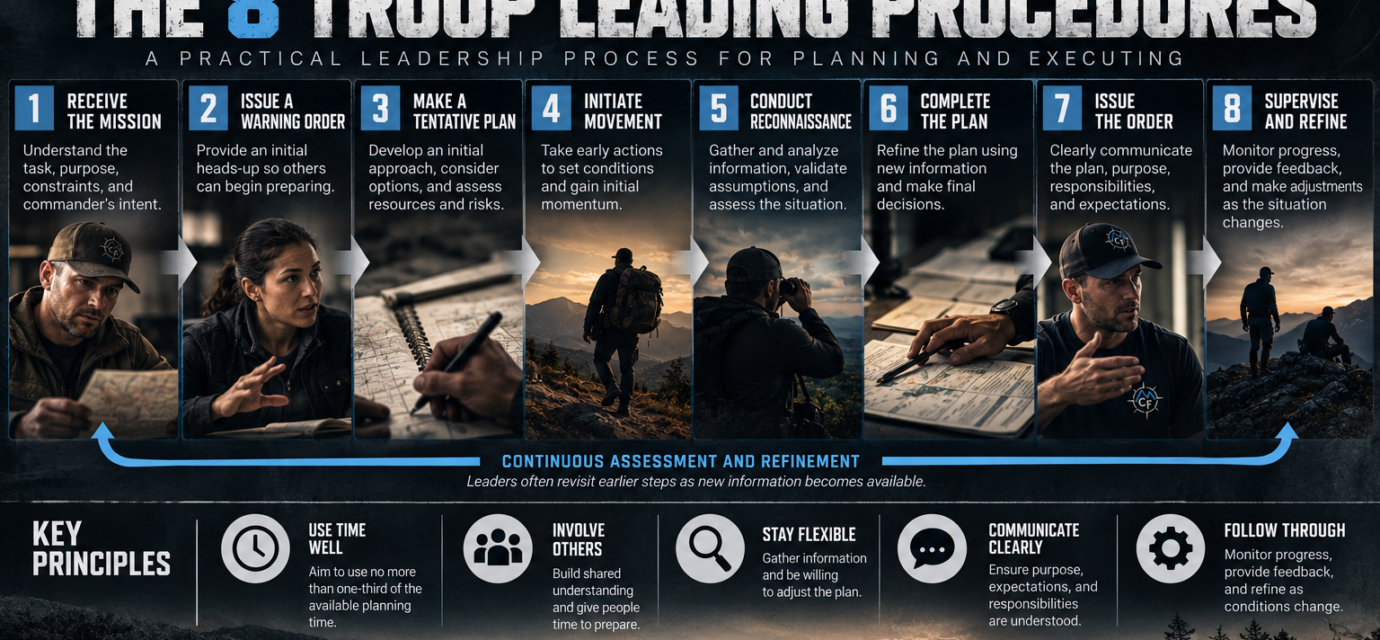
The U.S. Army’s TLPs provide a practical framework for planning, preparing, and executing missions.
1. Receive the Mission
Understand what needs to happen and why. What does success look like? What resources and constraints do you have?
2. Issue a Warning Order
Give people a heads-up. You don’t need every detail figured out before helping others prepare. Early communication gives everyone more time.
3. Make a Tentative Plan
Develop an initial approach. Consider your options, available resources, potential obstacles, and risks. Remember, it’s tentative for a reason.
4. Initiate Movement
Start what you can. Some preparations can begin before the entire plan is complete. Don’t allow planning to become an excuse for inaction.
5. Conduct Reconnaissance
Get a better understanding of the situation. Gather information, seek different perspectives, and challenge your assumptions.
6. Complete the Plan
Use what you’ve learned to refine your approach. Establish responsibilities, allocate resources, and make the necessary decisions.
7. Issue the Order
Communicate the plan. Make sure everyone understands the purpose, expectations, responsibilities, and next steps. Remember, delivering a message doesn’t guarantee understanding.
8. Supervise and Refine
Follow through. Monitor progress, support your people, provide feedback, and make adjustments as conditions change.
More Than a Checklist
One of the most important lessons I learned was that these steps aren’t necessarily linear. You might be working through several simultaneously, or returning to an earlier step as new information becomes available.
Another valuable principle is the Army’s one-third/two-thirds rule. When circumstances allow, leaders should use no more than one-third of the available time for their own planning, leaving the remaining two-thirds for their people to prepare.
Think about that for a moment.
How often do leaders spend so much time planning, debating, or making decisions that everyone else is left scrambling to execute?
Good leadership means recognizing that other people’s time matters just as much as your own.
But perhaps the greatest value of the TLPs is the mindset they develop.
Understand the mission. Communicate early. Make a plan. Take action. Verify your assumptions. Refine your approach. Communicate clearly. Follow through.
These are habits that become more natural with practice.
From Military Leadership to Everyday Life
Throughout my military career, I applied these principles to increasingly complex responsibilities. The missions changed, the teams grew, and the stakes varied considerably.
But the underlying process remained useful.
Since retiring, I’ve found the same approach works in organizational leadership, training and development, business, and even personal responsibilities.
Of course, not every situation requires sitting down and deliberately working through eight steps. Sometimes decisions need to happen quickly. Other times, we have the luxury of careful planning and collaboration.
That’s the value of developing a framework until it becomes intuitive. You learn when to slow down, when to seek input, when to take action, and when to adjust.
And while these procedures provide a valuable process, they don’t replace the character, judgment, or interpersonal skills necessary to lead effectively.
They simply give us a practical way to put those qualities to work.
Be That Leader Now
In my Be That Leader Now workshop, we explore the characteristics and behaviors of effective leaders. We talk about character, credibility, relationships, and the responsibility to positively influence others.
But leadership also requires action.
You don’t need to command a military unit or hold an executive title to benefit from a disciplined approach to getting things done.
The next time you’re facing an unfamiliar responsibility, a complicated project, or a challenge that seems overwhelming, consider these eight steps.
Start with understanding what needs to happen. Give others time to prepare. Develop a plan, but remain flexible. Communicate clearly, take action, and follow through.
Leadership isn’t just about having the right intentions. It’s about turning those intentions into meaningful action.
And sometimes, the most valuable leadership tools are the ones we’ve been carrying with us for years.
Relentlessly pursue a better self and inspire others to do the same.
Fit for Function. Ready for Life.
Source: U.S. Department of the Army, ATP 3-21.8, Infantry Platoon and Squad, Troop Leading Procedures. The personal reflections and civilian applications presented here are my own.