

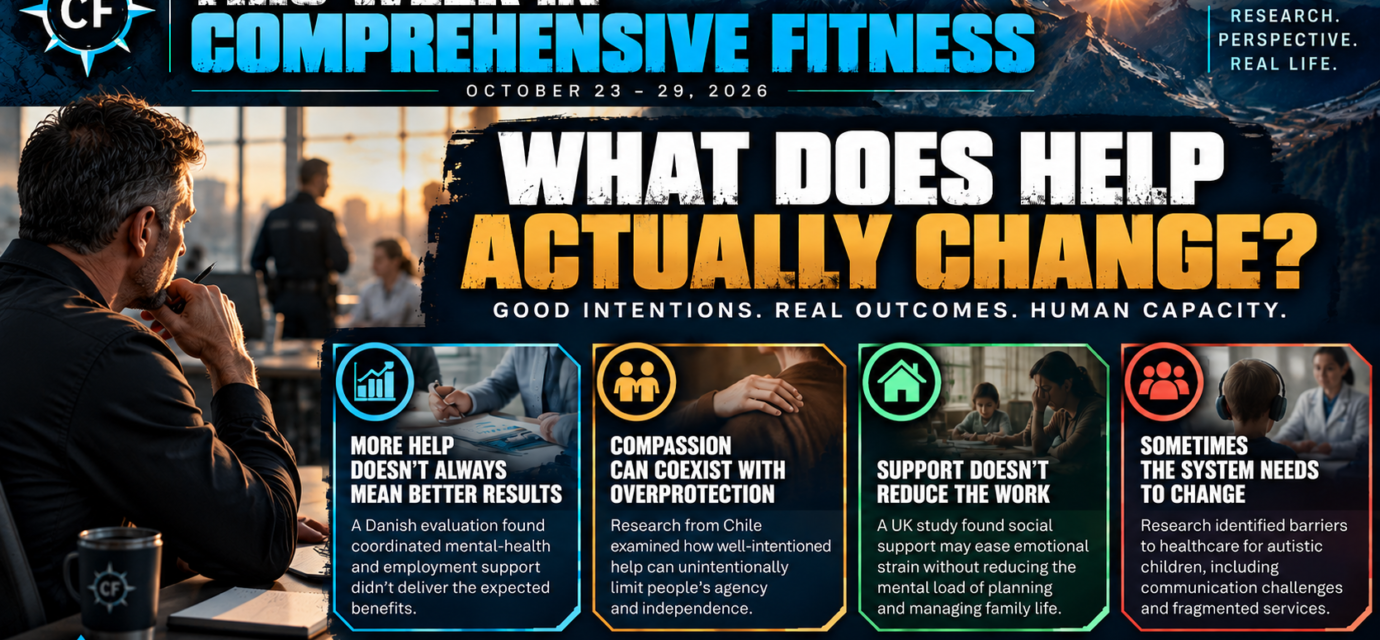

What Does Help Actually Change?
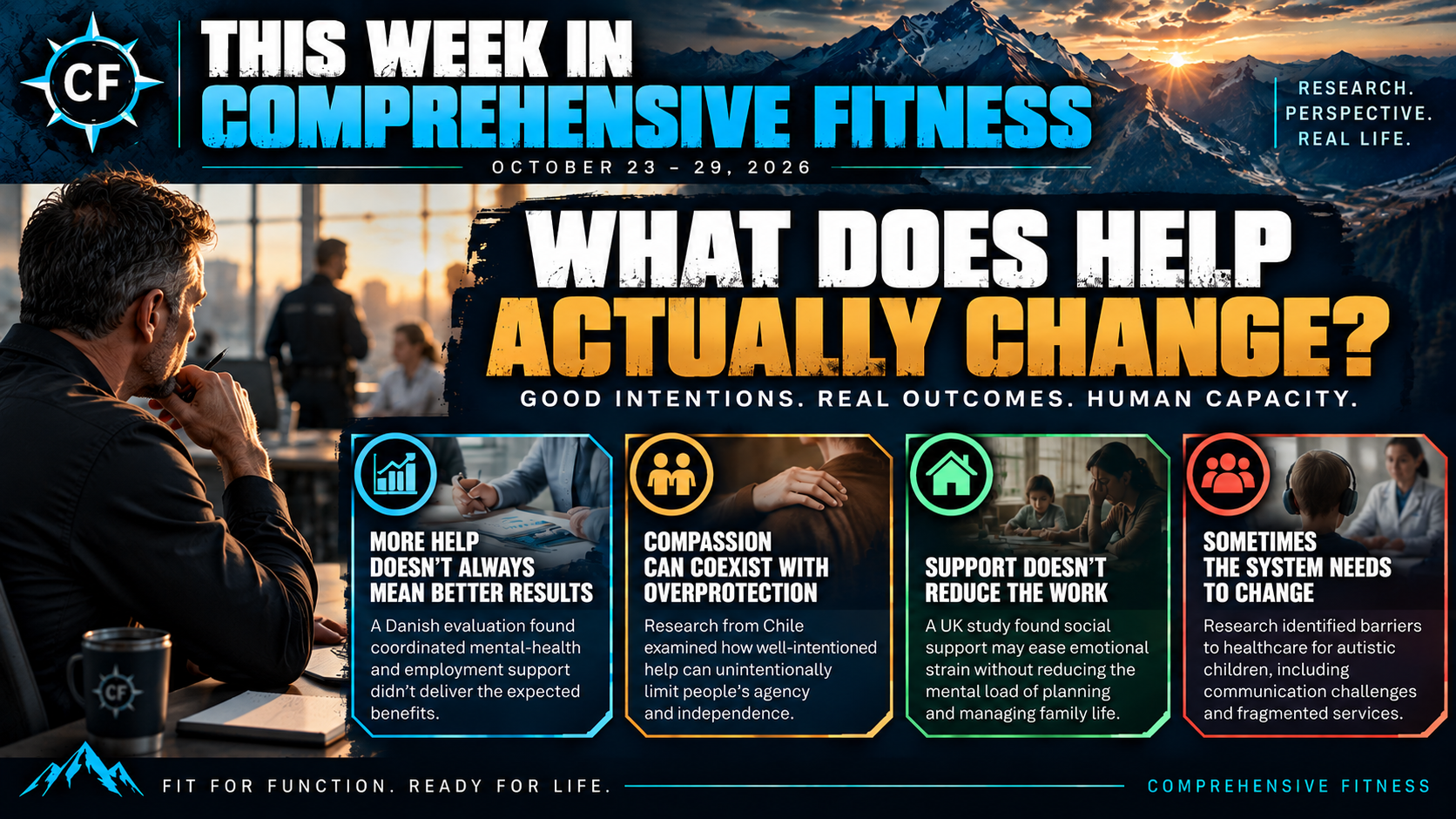
Good intentions matter. So do outcomes, dignity, and the conditions people live in.
A few studies caught my attention this week, and they left me thinking about a question that sounds pretty simple:
When we say we’re helping somebody, how do we know we’re actually helping?
I don’t mean whether our intentions are good. Most people who work in healthcare, education, leadership, or employee wellness genuinely want to make things better.
I’m talking about what changes in a person’s life because of what we do.
When More Services Don’t Produce Better Outcomes
One study published this week looked at two randomized trials in Denmark.
The participants had been off work for at least four weeks because of depression, anxiety, or stress-related conditions. Researchers compared usual services with additional mental-health care and with a program that combined mental-health care and vocational rehabilitation.
That sounds reasonable.
People are dealing with health problems that affect their ability to work. Why not coordinate the services?
But the economic evaluation, which followed outcomes for two years, found that neither additional approach was cost-effective compared with usual services.
Both increased societal costs, and neither produced a significant improvement in health-related quality of life.
Now, that’s not proof that mental-health care doesn’t work. It’s not proof that wellness programs are a waste of money.
It’s a finding about particular programs, for particular people, in Denmark’s system.
But it does challenge an assumption I think we make too easily:
If we offer more services, we’ve necessarily provided better support.
We need to ask what people can actually do, experience, or manage differently.
And we can’t reduce the answer to whether an employer saved money.
Returning to work matters. So do health, dignity, family life, and the ability to participate in things that matter to the person.
When Compassion Becomes Overprotection
Another study, this one from Chile, examined something the researchers called stigma by compassion.
Through interviews with people receiving mental-health services and the professionals working with them, they found examples of genuine affection and concern existing alongside assumptions that the person couldn’t manage their own life.
Sometimes that led to overprotection.
Here’s the uncomfortable part:
People receiving that help sometimes valued it. The relationship could feel caring while still limiting opportunities for independence and choice.
This was qualitative research, not a test proving that every supportive relationship causes harm.
And the researchers also recognized that some people face very real structural barriers. We shouldn’t turn a conversation about agency into an excuse to abandon people who need help.
Still, it’s a worthwhile question for a parent, supervisor, coach, caregiver, or friend:
Am I making room for this person’s capabilities, or am I deciding what they’re capable of before they get the chance?
The Invisible Work of Family Life
Now let’s move from healthcare and the workplace into family life.
Researchers followed 293 parents in the United Kingdom over 35 days around Christmas.
They repeatedly asked about the mental work of planning and organizing family life, how stressed people felt, and whether they were hiding their emotions.
The mental load and stress tended to feed into one another.
Higher mental load predicted more stress at a later check-in, and higher stress predicted more mental load.
Social support was associated with less emotional suppression, but it wasn’t associated with a reduction in the overall stress or planning burden.
That distinction matters.
Sometimes being there for somebody helps them feel less alone.
That’s valuable.
But it doesn’t necessarily take anything off their plate.
If one parent is still coordinating every appointment, remembering every deadline, planning every meal, and anticipating every problem, telling them they’re appreciated may be kind.
It isn’t the same as sharing the work.
The study was observational, focused on a particular holiday period, and it doesn’t prove what intervention would work.
But it gives us a better question to ask.
Are we offering encouragement, or are we also changing the conditions that make life difficult?
Sometimes the System Needs to Change
A separate study published this week looked at healthcare access for autistic children in the United Kingdom.
The researchers interviewed parents and healthcare professionals.
They heard about inconsistent communication, fragmented services, and the practical consequences of systems that aren’t flexible enough for the people using them.
Some of the adjustments people described were remarkably ordinary:
A quieter setting, more time, better communication, or a different approach to an appointment.
That study was small and qualitative, so it doesn’t establish the effectiveness of any one adjustment.
But it reminds us that helping somebody isn’t always about giving them another skill to practice.
Sometimes we need to make the environment more usable.
What This Means for Comprehensive Fitness
This is what I mean when I talk about Comprehensive Fitness.
Physical health doesn’t stop at the gym.
Emotional health doesn’t stop with identifying your feelings.
Family life doesn’t operate separately from work, finances, relationships, or the environment around us.
We all have some responsibility to develop our own capabilities.
And the people and organizations around us have responsibilities, too.
So here’s what I’m carrying into the weekend.
Before we congratulate ourselves for offering help, maybe we should ask three things.
- Did we understand the problem the person was actually facing?
- Did our response respect their dignity and capacity?
- And did anything meaningful improve?
We won’t always have easy answers.
But if the help we’re providing isn’t changing anything meaningful, we owe it to the people we’re trying to serve to find out why.
That’s something worth thinking about.
Fit for Function. Ready for Life.
Research Behind This Week’s Conversation
The following studies informed this week’s discussion. They represent different kinds of evidence, and their findings should be interpreted within the populations and settings studied.
- Coordinated Mental Healthcare and Return-to-Work Support (Denmark).
Cost Effectiveness and Resource Allocation, October 28, 2026.
Economic evaluation of two randomized trials examining coordinated mental-health and employment interventions. The evaluated interventions increased societal costs without demonstrating cost-effectiveness relative to usual services. - Overprotection and Stigma by Compassion in Mental Healthcare (Chile).
Discover Mental Health, October 28, 2026.
Qualitative research examining how well-intentioned professional support can coexist with assumptions that limit service users’ autonomy. - Parenting Stress Spirals and a Gendered Labour Division Over the Christmas Holidays.
Communications Psychology, October 24, 2026.
Repeated observations from 293 British parents exploring relationships among cognitive labor, stress, emotional suppression, and social support. - Understanding Healthcare Access for Autistic Children in the UK.
Journal of Autism and Developmental Disorders, October 23, 2026.
Qualitative interviews identifying communication, accommodation, and service-coordination barriers.
Research note: These studies do not collectively establish a single causal explanation for effective support. The connections discussed in this article are an interpretation of their findings, not a tested intervention model.