



Emotional Fitness
Emotional awareness is a skill, not a personality trait. Learn to recognize what you feel, understand your thinking, respond intentionally, and recover when life gets difficult.
WHAT IS EMOTIONAL FITNESS?
Awareness is a skill. Not a personality trait.
Emotional fitness is the capacity to recognize and understand emotions, regulate our behavior when emotions run high, respond to challenges intentionally, and recover after difficult experiences. These are learnable skills that improve with awareness, practice, reflection, and support.
Emotions are not problems to eliminate. Anger can draw attention to a crossed boundary. Fear can alert us to uncertainty. Sadness may accompany loss. The goal is neither perpetual happiness nor perfect calm. It is to notice what is happening and retain more choice in what happens next.
Within the nine-domain Comprehensive Fitness framework, emotional fitness supports and is influenced by physical recovery, family relationships, social connection, work, learning, and purpose. It is one capacity within a much larger life.
THE ESSENTIAL FOUNDATION
Emotional literacy: notice it, name it, explore it.
Emotional literacy is the ability to recognize, differentiate, and describe what we feel. “Bad,” “stressed,” or “fine” may be a starting point, but a richer emotional vocabulary gives us better information. Disappointed is different from embarrassed. Apprehensive is different from threatened. Resentful is different from irritated.
Use the Comprehensive Fitness Feelings Wheel as a prompt for reflection, not a test or diagnosis. Begin in the center with one of seven broad emotional families, then move outward to find words that fit your experience. You can feel more than one emotion at a time, and the words are invitations to explore, not rigid categories.
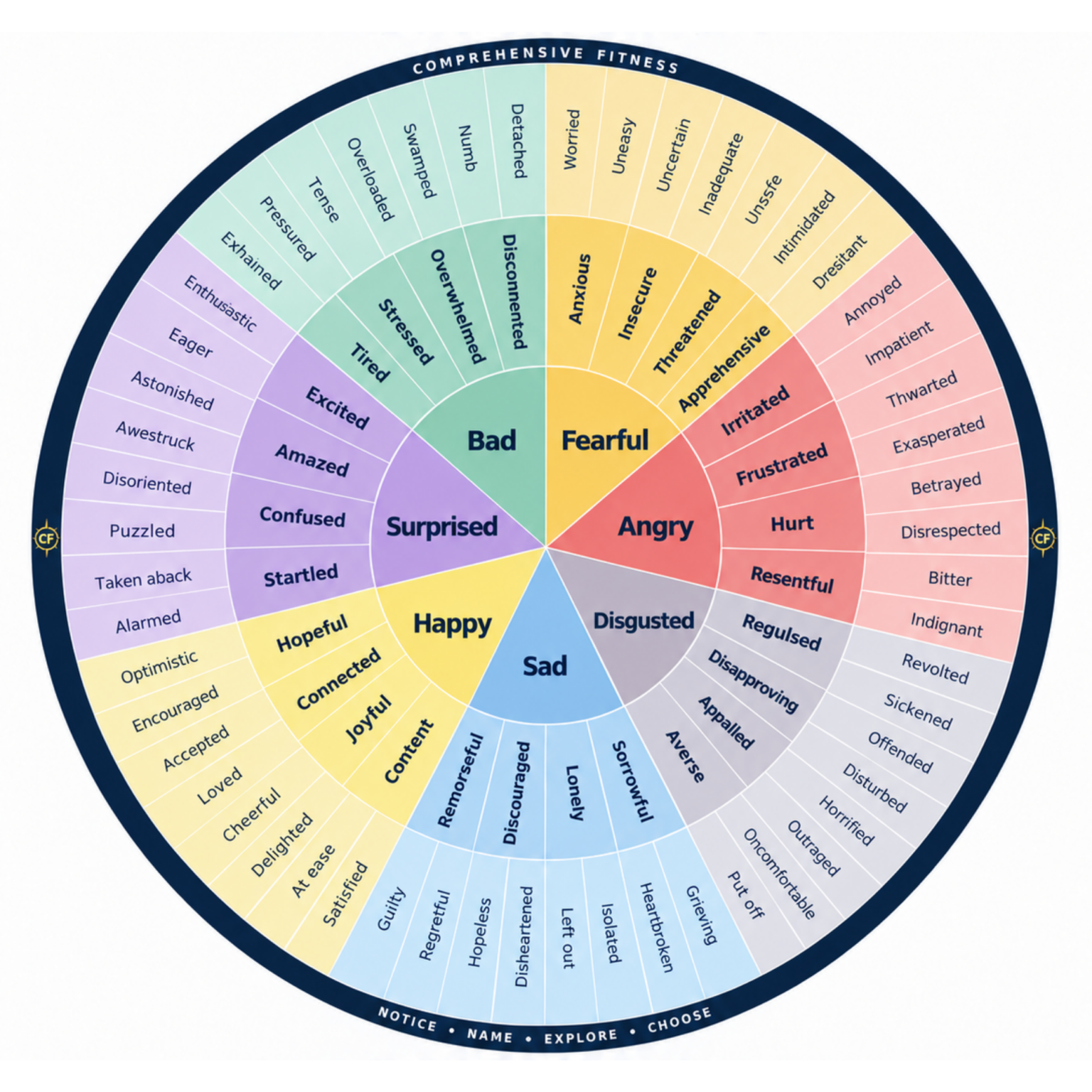
Try the wheel in four steps
Pay attention to your body, thoughts, and shifts in energy or behavior.
Choose a broad emotion, then find a more precise word on the wheel.
Ask what happened, what matters, and which assumptions you may be making.
Decide whether to express, pause, seek support, solve a problem, or simply allow the emotion to pass.
For the background, vocabulary, and examples, read The Feelings Wheel: A Tool to Expand Your Emotional Vocabulary. The CF version shown here uses seven core emotions; the older article should be updated to match this visual.
TRAIN THE MIND
Thinking traps: recognize them, then find your footing.
An event and our interpretation of that event are not always the same thing. Thinking traps, also called cognitive distortions, are predictable habits of interpretation that can amplify anxiety, anger, shame, or hopelessness. Learning to recognize them gives us a chance to test the story before acting on it.
“They ignored me because they dislike me.” We assume we know another person’s motives.
“This mistake will ruin everything.” We jump to the worst possible outcome.
“If I cannot do it perfectly, I failed.” We overlook the middle ground.
“This must be about me.” We take responsibility for things we may not control.
What if you are already caught in a trap?
The objective is not to never fall into one. We train to notice it sooner, interrupt automatic conclusions, recover our balance, and choose a better response. Ask: What do I know? What am I assuming? What else could explain this? What action would be useful even if I am wrong?
Continue with Thinking Traps: How Cognitive Distortions Hijack Your Mind.
UNDERSTAND YOUR OPERATING RANGE
The window of tolerance: when stress changes what we can access.
The window of tolerance is a useful model for understanding how our level of nervous-system activation affects attention, decision-making, connection, and behavior. Inside our workable range, we can experience difficulty while still thinking and responding flexibly. Outside it, those capacities may narrow.
High activation: racing thoughts, urgency, irritability, panic, or agitation.
Enough flexibility to feel emotions, stay present, think, connect, and respond.
Low activation: numbness, withdrawal, feeling disconnected, or shutdown.
The goal is not to feel calm all day. It is to recognize when your state is changing and practice ways to return to effective functioning. Movement, grounding, paced breathing, connection, rest, and professional support can all have a role, depending on the situation.
Video introduction to the window of tolerance. The written explanation above remains available if you prefer not to watch.
RESPOND INSTEAD OF REACT
Circle of Concern. Circle of Influence. Intentional response.
Some challenges deserve our concern even when they sit outside our control. The Circle of Concern helps us acknowledge what matters. The Circle of Influence helps us find where our preparation, choices, conversations, boundaries, and actions can make a difference.
Being proactive is not the same as ignoring problems or denying emotion. It is recognizing a feeling, examining the situation accurately, and directing energy toward an intentional next step. Reframing is useful when it helps us see additional possibilities without minimizing what happened.
What matters to me, but may not be mine to control?
What can I affect through my own words, preparation, choices, or support?
What action reflects my values and improves this situation, even slightly?
Explore the full exercise in #BetterByFriday: Control the Controllables, inspired by Stephen Covey’s Circles of Concern and Influence.
PRACTICE AND RECOVERY
Build emotional fitness one response at a time.
A person can be emotionally fit and still become overwhelmed. Recovery matters as much as preparation. The aim is to notice sooner, reduce harm, seek help when needed, and come back with greater understanding instead of judging yourself for having an emotional response.
Use the wheel. Name one emotion and one physical cue. No need to solve it immediately.
Notice a recurring thinking trap. Write down what happened, what you assumed, and one alternative explanation.
List early warning signs, two practices that help you reset, and one person you can contact when you need support.
A five-question check-in
- What am I feeling, specifically?
- What story am I telling myself?
- Is my current state helping or narrowing my ability to respond?
- What is within my control or influence?
- What intentional next step would serve me and others?
Emotional fitness is supported by physical fitness, and can help us navigate relationships within family fitness and social fitness. Difficult or persistent symptoms may call for help from a qualified health professional.
KEEP LEARNING
Continue exploring emotional fitness.
Expand emotional vocabulary and practice precise naming.
Recognize interpretations that can intensify distress.
Shift attention toward meaningful action and influence.
THE COMPLETE FRAMEWORK
The Nine Domains of Comprehensive Fitness
Explore all nine interconnected domains. Each develops a different capacity, and growth in one can support progress in the others.
 Physical
 Intellectual
 Spiritual
 Social
 Family
 Environmental
 Financial
 Occupational
Return to What Is Comprehensive Fitness? to see how the nine domains work together.
Keep exploring
Latest from Emotional Fitness
-

Self and Buddy Aid: A Missing Piece of Workplace Wellness
Self and Buddy Aid: A Missing Piece of Workplace Wellness Most workplaces have gotten pretty good at giving people wellness resources. An app. An…
-

Don’t Skip the Rep: AI, Desirable Difficulty, and Building Capacity
Don’t Skip the Rep: AI, Desirable Difficulty, and Building Capacity Guess before Google. I’ve been saying that for years. Before I search for the…
-

Fit for What?
Fit for What? Fitness makes more sense when we stop asking how healthy someone looks and start asking what their life actually requires them…